You’ve got the vision — an open balcony, a sleek staircase, an outdoor deck that flows into the horizon. Glass railings can make that vision a reality. But before the first panel goes up, California law has something to say about it.
Section 1015 of the California Building Code (CBC) governs guardrail and glass railing requirements statewide, and getting it wrong can mean failed inspections, costly retrofits, or worse — a life-safety hazard. Whether you’re remodeling a hillside home in Orange County or upgrading a San Diego condo balcony, understanding these rules protects your investment.
Shower Door Masters, with over 25 years of glass installation experience across Southern California, build every project to meet or exceed these standards from day one.
What Is CBC Section 1015 and Why Does It Apply to You?
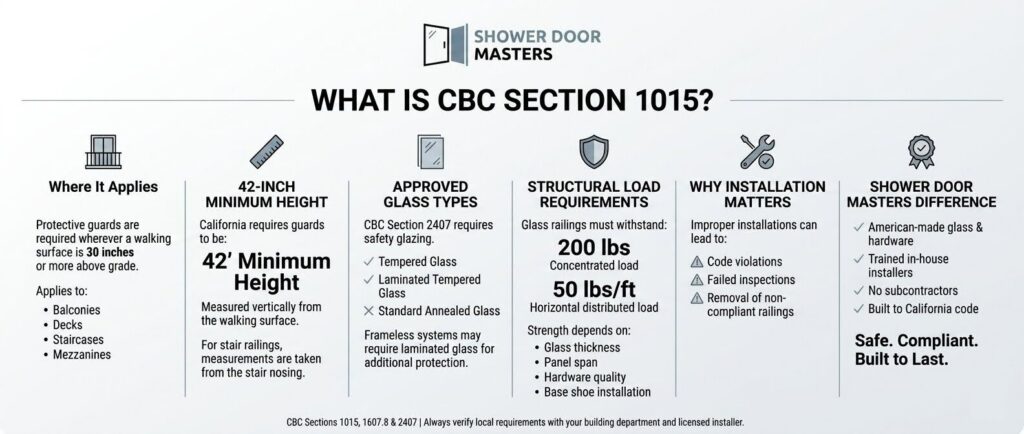
Section 1015 of the California Building Code establishes the requirements for guards — the protective barriers required wherever there is a walking surface elevated 30 inches or more above the floor or grade below. Glass railings used on balconies, decks, staircases, and mezzanines all fall under this section. If you’re a homeowner planning any elevated outdoor or indoor railing system, this code applies to your project whether it requires a permit or not.
The code doesn’t just dictate height — it specifies load requirements, glass type, panel thickness, fastener standards, and top rail configurations. Ignoring any one of these can result in a citation from your local building department or, in some cases, mandatory removal of non-compliant installations. Understanding the full scope of Section 1015 before you start is the smartest move a homeowner can make.
Minimum Height Requirements: The 42-Inch Rule
One of the most fundamental requirements under Section 1015 is height. For most residential applications — balconies, decks, open sides of stairs — the CBC requires guards to be a minimum of 42 inches in height measured vertically from the walking surface. California amended the base International Residential Code to eliminate the shorter 36-inch allowance entirely, so many older homes built to the prior standard may technically be out of compliance with current requirements.
For glass stair railings specifically, the required height is measured from the stair nosing, which changes the geometry of installation. Glass panels on stair railings must be sized and positioned carefully to maintain that measurement at every point along the run. A licensed installer will account for these angles during the design phase — not after the glass is already cut.
Glass Specifications: Not Just Any Panel Will Do
Section 2407 of the CBC requires that glass used in railing systems be classified as safety glazing under CPSC 16 CFR Part 1201 or ANSI Z97.1. In practice, this means tempered or laminated tempered glass — standard annealed glass is never permitted in a railing application. Tempered glass is heat-treated to be significantly stronger than standard glass and, crucially, shatters into small pebbles rather than large dangerous shards if broken.
Laminated tempered glass is the premium option and is often required for frameless systems where there is no continuous top rail. Laminated panels hold together even when broken, preventing glass from falling onto people below. For frameless glass railing systems — popular in modern California homes — the CBC may require laminated glass depending on the specific configuration and local amendments. Always verify which glass type is required with your installer before purchasing panels.
Structural Load Requirements: Glass Has to Hold More Than Its Own Weight
A glass railing isn’t just decorative — it has to function as a structural guard. Section 1607.8 of the CBC requires residential guards to withstand a 200-pound concentrated load applied at any point along the top rail, and 50 pounds per linear foot applied horizontally as a distributed load. These aren’t soft suggestions — they’re engineering minimums that must be met through the combination of glass thickness, panel span, and post or base shoe hardware.
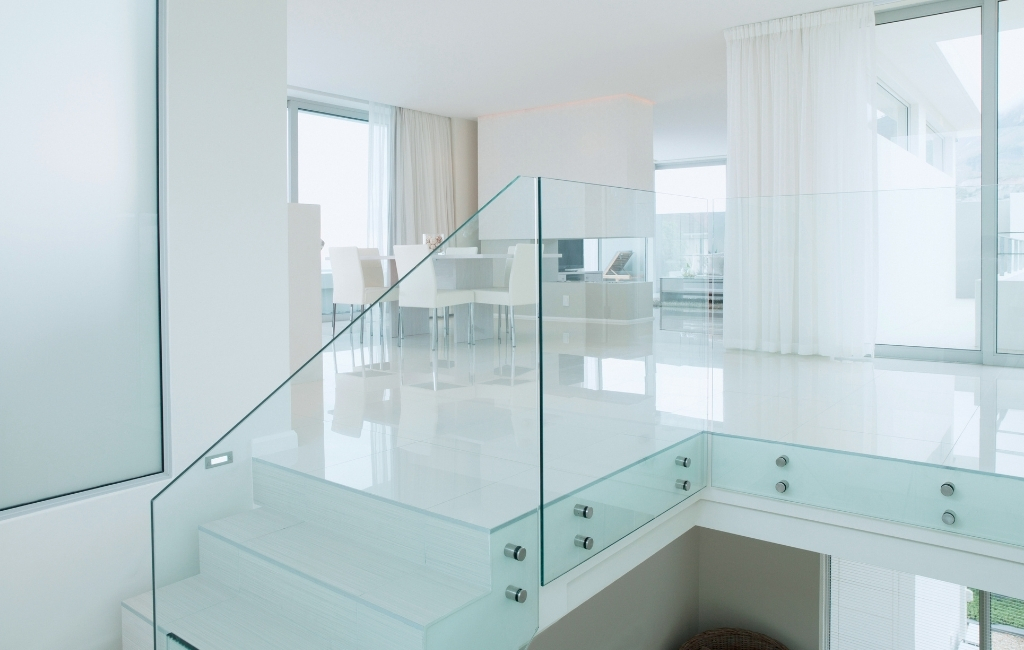
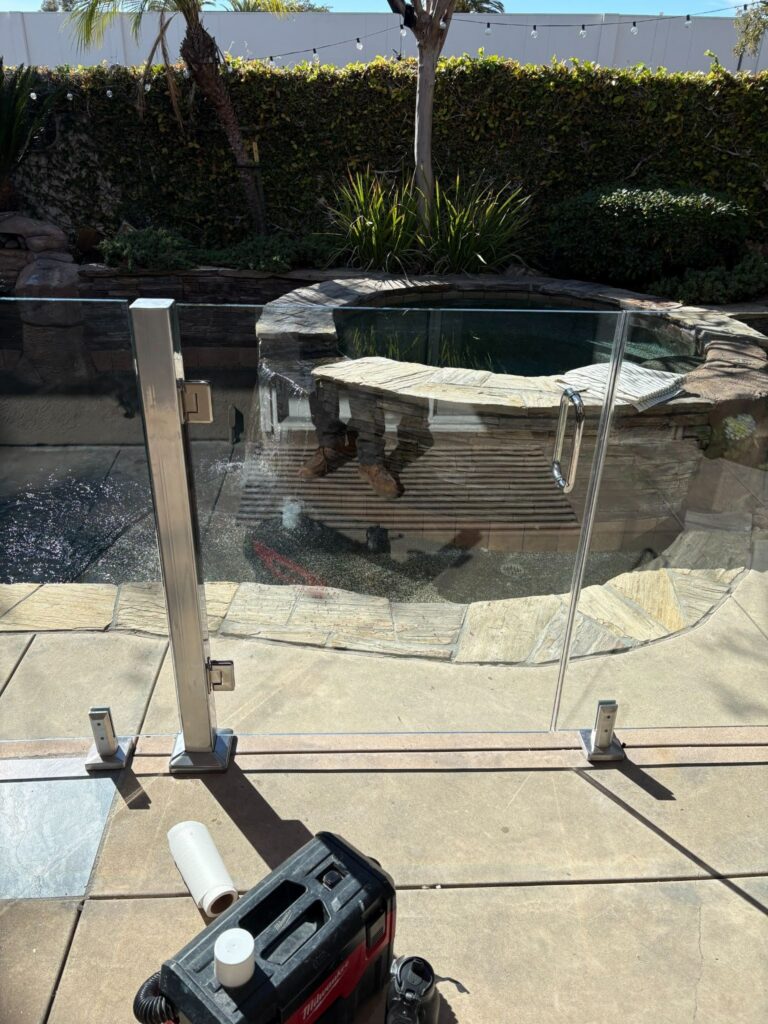
For frameless glass systems with no metal posts — a design choice prized for its minimalist aesthetic — the base shoe that anchors each panel to the deck or floor must handle the full structural load. The quality and installation method of that base shoe is where corners are often cut.
Shower Door Masters uses American-made glass and hardware, employing its own trained installers (not subcontractors) to ensure every connection point is built to code and built to last.
Permitting and Inspections: A Logic Framework for California Homeowners
California homeowners searching for glass railing permit requirements often encounter vague guidance like “you may need a permit.” In practice, the permit requirement is triggered by clear, identifiable design and construction conditions — not guesswork. Under CBC §1015.2, any new deck, balcony, porch, mezzanine, or similar elevated walking surface more than 30 inches above grade will almost always require a permit, because it establishes a new structural guard condition introducing life-safety loads that must be reviewed by the local Authority Having Jurisdiction (AHJ). If you’re installing a new glass railing system as part of a new or expanded elevated surface, permitting is effectively mandatory in nearly all California jurisdictions.
For railing replacements, the permit requirement depends on whether the structural or load-resisting system is altered. A like-for-like replacement — identical height, identical anchorage points, identical system type — may sometimes be exempt, but once you change railing height, base shoe anchorage, post spacing, or switch from framed to frameless glass, a permit is typically required because the system’s load path changes and must be re-reviewed. In multifamily and condominium buildings, permits are almost always required because shared common-area railings are considered life-safety elements subject to stricter enforcement.
This is reinforced by California’s balcony inspection laws — SB 326 for condominium associations and SB 721 for multifamily rental buildings — which require periodic inspections of exterior elevated elements and often trigger permit review when repairs or replacements are identified. Even when a project appears minor, the local AHJ can override assumptions through local amendments, making permit determination a function of new structural load creation, alteration of load paths, occupancy type, and jurisdictional oversight — not simply material replacement.
Working with a licensed contractor like Shower Door Masters (CSLB #1113783) means your project is documented correctly and ready to pass inspection without costly delays. Our team handles permit acquisition directly, so you don’t have to navigate city offices alone.
Get Your Glass Railing Quote — Free, Same Day
If you’re planning a balcony, deck, or stair railing project in Southern California, Shower Door Masters makes it easy to get started. Centrally located in Anaheim, we serve all of Orange, Los Angeles, San Diego, Riverside, and San Bernardino counties — and can typically reach your property in under an hour. Every project comes with a free consultation, same-day estimate, and a warranty on both the product and installation.
Call (949) 966-0601 or visit showerdoormasters.com/glass-railing to schedule your free estimate. Our team will walk you through every code requirement, design option, and glass type — so your railing looks stunning and passes inspection the first time.
Transparent About What Matters Most
California’s glass railing code exists for one reason: to keep people safe at height. Section 1015 of the CBC covers everything from panel height and glass type to structural load ratings and permit triggers — and navigating it without an experienced installer can lead to expensive mistakes. The good news is you don’t have to figure it out alone.
Shower Door Masters has been Southern California’s trusted glass installation company for over 25 years. Our team handles every detail — code compliance, permit acquisition, custom fabrication, and flawless installation — all backed by a warranty and American-made materials. Call (949) 966-0601 or visit showerdoormasters.com/glass-railing for your free, same-day estimate today.
Frequently Asked Questions
Does CBC Section 1015 apply to my existing glass railing if I’m not making changes?
Generally, existing railings are grandfathered under the code in effect at the time of installation. However, if you’re making any modifications, additions, or repairs, the current CBC will apply to the altered portion. If your home is being sold, a home inspection may flag non-compliant railings as a safety issue even if they’re technically grandfathered.
Can I use frameless glass railings in California?
Yes — frameless glass railing systems are permitted under the CBC, provided they use the correct glass type (typically laminated tempered), proper base shoe hardware rated for structural loads, and meet all height requirements. Many California homeowners prefer frameless systems for their unobstructed views and modern aesthetic. Shower Door Masters offers frameless, semi-frameless, and clamped systems tailored to each application.
What’s the difference between tempered and laminated tempered glass for railings?
Tempered glass is heat-strengthened and breaks into small, relatively safe pebbles. Laminated tempered glass has a plastic interlayer bonded between two tempered panels, so when it breaks, the pieces stay adhered to the interlayer. Laminated is required in certain configurations — particularly frameless systems or anywhere falling glass poses a hazard to people below.
Do I really need a permit to replace an existing glass railing?
In most California cities and counties, yes — if the replacement alters the load path, height, anchorage method, or system type, a building permit is required. Your contractor can help determine what’s required in your specific jurisdiction. Shower Door Masters handles permit acquisition as part of the installation process, so homeowners don’t have to manage this alone.
How thick does the glass need to be for a residential railing?
Minimum thickness depends on the panel span and whether the system is framed or frameless. For typical residential applications, 3/8-inch tempered glass is the minimum in framed systems, while frameless systems often require 1/2-inch or thicker panels. An experienced installer will specify the correct thickness based on your layout and the structural load requirements under CBC Section 1607.8.